Driving in Iceland in Winter 2026: Tyres, road.is, When to Skip
Winter tyres and road.is decide the day — not a highland 4x4. When to hire at KEF, when to skip self-drive, and when a tour is smarter (2026).
Written from general Iceland winter-travel knowledge for 2026. Road colours, tyre rules and closures change with the day — confirm on road.is, safetravel.is and your hire contract before you drive.
Book a winter self-drive — or skip it
Compare a winter-tyre hire first. If you land after dark, Flybus in and a 101 hotel — then decide in daylight.
Compare cars at Keflavík AirportKeflavík Airport · Reykjavík · via DiscoverCars.com
You book and pay the partner on the next page. We earn a commission at no extra cost to you.
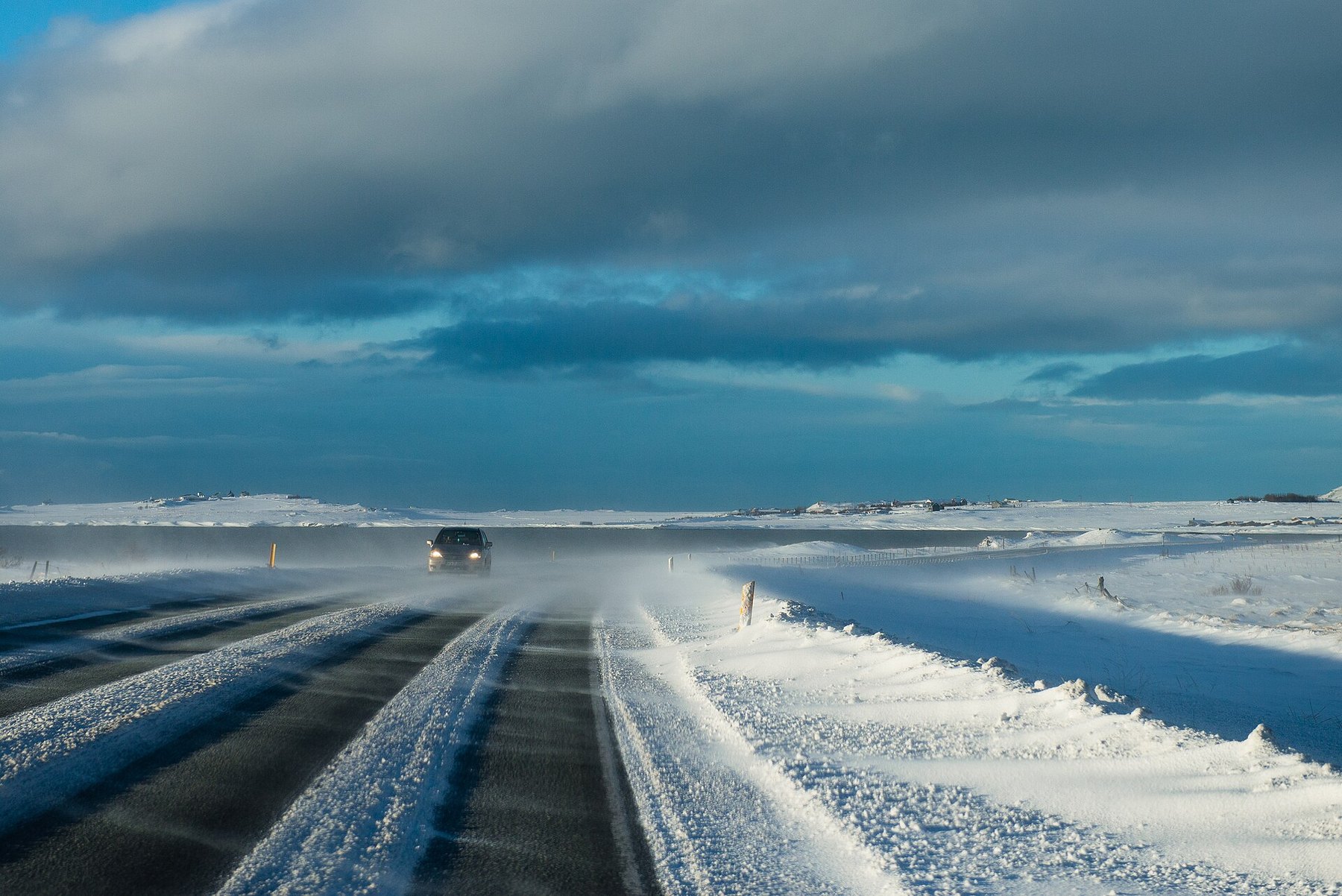
Winter driving in Iceland is not automatically a bad idea — and it is not a cute snow-globe version of a summer self-drive. Short daylight, ice you cannot see, and wind that moves cars are the real constraints. Plenty of visitors hire a car in November–March and have a calm south-west trip. Plenty of others should have booked a tour and did not.
A winter self-drive starts the night you land, not at the first waterfall. Take the Flybus from Keflavík if you should not drive after a red-eye, sleep the first night in 101 / harbour / Laugavegur, then compare a winter-tyre hire for Keflavík or Reykjavík pickup. Came for the lights? Book a small-group hunt and skip the midnight lay-by. Prefer someone else at the wheel for the week? A multi-day tour is the other path — this page stays the driving brief. You compare and book the partners on those pages; we earn a commission at no extra cost to you.
This is the winter driving pillar: when a rental is a good idea, what to hire, how to read the official sources, and when to hand the keys back. Confirm winter tyres in writing, then compare Iceland car hire before you leave Reykjavík. Pair it with rent a car in Iceland for class, Keflavík airport car rental for the desk, Iceland car rental insurance for excess and gravel, the Golden Circle self-drive and South Coast self-drive for the two classic days, the Northern Lights 2026–2027 season if aurora is why you came, and Iceland in winter for the season beyond the car.
When winter driving is a good idea — and when it is not
Treat “winter” as roughly November to March, with October and April as shoulder months that can still throw ice and storms. The question is not “is Iceland driveable in winter?” It is “is your trip, this week, a self-drive?”
- Good idea if you are a confident cold-weather driver, based in the south-west (Reykjavík, Golden Circle, South Coast toward Vík), travelling outside the darkest weeks, and willing to drop a day when road.is says no.
- Usually a bad idea if this is your first time driving in snow or ice, you land after dark on day one and want to push to Vík that night, you have a rigid “must see X on Tuesday” list, or you are picturing a full Ring Road circle in December.
- Skip the car if the headline reasons you came are Northern Lights hunts, ice caves or glacier walks — those already need a guide, and a rental you park for three tour days is expensive scenery.
- A full winter Ring Road is a specialist project, not a first-timer itinerary. Shrink the map or book a multi-day guided tour. Hire notes for the summer loop sit in the Ring Road car hire guide.
If in doubt, don’t. A missed sight is a minor disappointment; a car off the road in a whiteout is not.
2WD vs 4x4 — and the tyres that actually matter
In winter the tyres matter more than the badge on the grille. Icelandic rentals in season should come with winter tyres (often studded or a serious winter compound). Confirm in writing at booking and again at pickup. A 4x4 on tired summer rubber is worse than a compact on proper winter tyres on paved Route 1.
- 2WD with winter tyres — enough for many south-west days on paved roads in reasonable conditions: Reykjavík, the Golden Circle, and a cautious South Coast when road.is is green or yellow. Not a licence to ignore warnings.
- 4x4 / compact SUV — the usual winter upgrade. Extra weight and drive help on snow-covered lots, mild hills and nasty crosswinds. Still useless if you outdrive the tyres or the forecast.
- Studded vs non-studded winter tyres — both exist. Studs help on ice; they are not magic in a gale. Ask what is fitted. Do not assume “SUV” means studs.
- High-profile vehicles and campervans — more sail area in the wind. In a winter storm they are the first to get shoved. A smaller car is often the calmer choice on the south coast.
- F-road 4x4s — irrelevant in winter. Highland tracks are closed. Paying for a mountain vehicle you will not legally use is a summer decision.
Pickup at Keflavík after a red-eye, in the dark, with wind on the Reykjanes peninsula, is a common first-hour scare. Take the Flybus and sleep in Reykjavík — start the self-drive when you can see the road. Desk notes sit in Keflavík airport car rental.
Wind, ice and visibility
Visitors arrive worried about snow and get surprised by wind. Open stretches of the south coast and the Reykjanes road to the airport are the usual classrooms.
- Car doors. Hold the door with two hands in a gust. Icelandic car-park folklore is full of doors bent against the wind — and rental bills to match. Park facing so the door is not a sail if you can.
- Crosswinds. Sudden gusts can move a car sideways, especially high-sided ones. Slow down on exposed coastal straights; both hands on the wheel; do not overtake into a blast.
- Black ice. Often invisible. Icelandic winter driving culture is slower than a GPS ETA. Match the locals. If you feel ABS or the car go light, ease off — do not brake like a city cab.
- Visibility. Snow, spindrift, low sun on wet asphalt, and spray. If you cannot see the next marker, you should not be at highway speed. Headlights on at all times (the law anyway).
- Daylight. Around the December solstice you get a few usable hours. Plan the Golden Circle or South Coast as the day, not as two ambitious days stacked. Drive the dark bits on familiar roads, not on a first visit to Vík.
road.is, safetravel.is and 1777
These three are the winter self-drive kit. Use them every morning, and again before you leave a car park if the sky has changed.
- road.is — colour-coded conditions and closures, updated through the day. A road that is fine at 9:00 can close by noon. Treat closed / impassable as absolute, not a challenge. Learn the colours before you travel so you are not decoding a legend in a blizzard.
- safetravel.is — alerts, weather-related advice, and the 112 / travel-awareness culture. Worth a bookmark; worth telling someone your route if you leave the south-west.
- 1777 — the Icelandic Road and Coastal Administration information line for conditions. Use it if you cannot interpret the map, not as a substitute for looking at it.
- vedur.is — wind and weather, including warnings. Wind warnings matter as much as snow forecasts.
GPS will happily route you toward a closed pass. The official map wins. If a local or a hotel desk says “don’t,” that also wins.
F-roads are closed in winter — do not go looking
F-roads (highland mountain tracks, often with unbridged rivers) are a summer system. In winter they are snowed in, closed, and not a sneaky shortcut to Landmannalaugar or the interior. Driving them out of season is how people get stuck, void insurance, and generate rescue headlines. The summer side — what an F-road is, 2WD fines, insurance, and why amateurs should not ford rivers — is Iceland F-roads: when you need a 4x4.
- Do not follow a summer blog pin into the highlands in January. The pin does not know the season.
- A 4x4 rental is not permission. Contracts often forbid F-roads even in summer; in winter the roads themselves are closed.
- Off-road driving on moss and open land is illegal year-round and heavily fined. Stay on marked, open roads.
- If the coloured mountains are the goal, read Landmannalaugar and the highlands and go in the summer window — or on a guided super-jeep when operators run. Do not freelance it in winter.
Closed means closed. Winter Iceland has more than enough paved scenery without collecting an F-road story you cannot finish.
Insurance notes that still matter in winter
Snow does not cancel gravel. Winter lots, salted roads, and wind-blown grit still chip glass and paint. Read the same checklist as the main hire guide — then be honest about winter extras.
- Collision excess — know the number before you are standing in a Keflavík queue. A cheap day rate with a huge excess is a worse bet on ice.
- Gravel protection — still relevant. Shoulders and car-park spurs do not go away because it is cold.
- Sand and ash — less of a summer-south-coast sandstorm story, still worth reading on the contract. Wind finds grit year-round.
- Windscreen and underbody — check whether chips and winter-scrape damage sit inside the excess.
- Door and wind damage — not always the heroic “storm story” you hope the desk will laugh off. Hold the doors.
- Your credit-card cover — Iceland exclusions are common. Confirm in writing before you travel; do not invent cover at the counter.
Photograph the car at pickup and return, including tyres, glass and door edges. The cover checklist is Iceland car rental insurance.
A winter driving checklist
- Winter tyres confirmed; 4x4 only if it matches the roads you will actually drive.
- road.is + vedur.is every morning, and 1777 if you need a human.
- Tank at least half full — rural pumps and weather both thin out.
- Daylight budgeted as the scarce resource. One ambitious day, not three.
- No F-roads. No “shortcut” through the highlands.
- A spare day in the plan. Weather delays are normal.
- A tour already in mind for the nights and caves you should not self-improvise.
When to take a tour instead
A guided day is not a failure of nerve. It is how you still see the country when the car is the wrong tool.
- Northern Lights — a small-group hunt chases a forecast you will not beat from a ring-road lay-by on your first night. Dates and tour-vs-drive sit in the 2026–2027 season hub; browse formats at Northern Lights tours.
- Ice caves and glacier walks — you cannot (and should not) freelance these. Start at ice cave tours.
- South Coast in a storm week — let a driver who reroutes for wind take the coastal day. You can still self-drive a calmer Golden Circle if road.is agrees.
- Solo travellers and dark arrivals — the rental + fuel + parking + stress often loses to two or three well-chosen tours on a long weekend. Take the Flybus and sleep in 101 instead of collecting keys at midnight.
How to assemble a winter self-drive so the hire actually happens
- Hold the first-night room — sleep in 101 / harbour / Laugavegur so you do not start Route 41 after a red-eye.
- Take the Flybus in if you land after dark — the KEF airport coach is the usual arrival, not a taxi scramble onto ice.
- Then compare the car — live rates on the Iceland car-hire landing (Keflavík or Reykjavík pickup). Confirm winter tyres in writing. Hiring basics sit in rent a car in Iceland; desks are Keflavík airport car rental; cover is Iceland car rental insurance.
- Read road.is every morning — a green south-west day is a self-drive; red or a storm warning is a skip. Do not treat a GPS ETA as a permit.
- Drive the opening day as its own day — the Golden Circle self-drive or a short South Coast self-drive toward Vík, not a December Ring Road raid from KEF.
- Hand the wheel away when the headline is aurora, ice caves, or a first snow drive — a small-group hunt or a multi-day tour is the backup, not a reason to hire a highland 4x4 for closed F-roads. Season dates sit in the Northern Lights 2026–2027 hub.
Related: rent a car in Iceland · Keflavík airport car rental · Iceland car rental insurance · Northern Lights 2026–2027 season · Golden Circle self-drive · South Coast self-drive · Ring Road car hire.
Frequently asked questions
Is it safe to drive in Iceland in winter as a first-timer?
It can be, on paved south-west roads, in a car with proper winter tyres, if you are already used to ice and you treat road.is closures as final. If you have never driven in snow, or you need a rigid itinerary, skip self-drive and book tours instead — especially for Northern Lights and ice caves.
Do I need a 4x4 in winter?
Not automatically. Winter tyres matter more than four-wheel drive on paved Route 1 in decent conditions. A 4x4 is a reasonable upgrade for confidence, snowy car parks and wind; it is not a pass to ignore road.is or drive F-roads, which are closed in winter.
When should I skip winter self-drive?
Skip the car if this is your first time on ice, you land after dark and want to push to Vík that night, you have a rigid “must see X on Tuesday” list, or the headline reasons you came are Northern Lights hunts, ice caves or glacier walks. A full winter Ring Road is a specialist project, not a first-timer itinerary. If road.is turns red or a storm warning is up, do not go — take a guided day instead.
Are F-roads open in winter?
No. Highland F-roads are a summer system and are closed in winter. Do not follow a summer itinerary pin into the interior. Landmannalaugar waits until the summer window or a guided highland trip. The summer 4x4 / F-road rules sit in the F-roads guide on this site.
What does road.is actually tell me?
It colour-codes driving conditions and shows closures, updated through the day. Use it every morning and before you leave a stop if the weather has changed. Closed or impassable means do not go — that is when to skip self-drive for the day. The 1777 phone line can talk you through the map; vedur.is covers wind warnings.
How do I start a winter hire from Keflavík?
If you land after dark or after a red-eye, take the Flybus into Reykjavík, sleep, then compare a hire with winter tyres confirmed in writing for KEF or city pickup. Start the self-drive in daylight on paved south-west roads. Desk notes sit in the Keflavík airport car rental guide; cover is the insurance page. If you do not want to own the winter roads, a Northern Lights hunt or a multi-day tour is the other path.
Is gravel insurance still worth it in winter?
Often yes. Winter does not remove chips from shoulders, car-park spurs or wind-blown grit. Know your collision excess, and do not assume snow cover equals a gentle road. No price here is a quote — read today’s excess on the booking.
Book it: related Iceland tours
Turn the plan into a trip — browse the experiences from this guide.


Keep reading
- Jökulsárlón Self-Drive 2026: Diamond Beach, Overnight EastJökulsárlón and Diamond Beach, 5–6 hours one way from Reykjavík. Overnight east — not a Vík day trip. Summer 2WD is enough — compare car hire before you leave.
- South Coast Self-Drive 2026: One Day from Reykjavík (2WD)One day from Reykjavík to Vík — not Jökulsárlón. Seljalandsfoss, Skógafoss, Reynisfjara. Summer 2WD is enough — compare car hire before you pick up at KEF.
- Iceland F-Roads: When You Need a 4x4 (and When You Don’t)What an Iceland F-road is, when you need a 4x4, why 2WD is fined, and why most first-timers should not ford rivers — plus when a normal car is enough.
- Iceland Ring Road Car Hire 2026: Vík, Jökulsárlón, AkureyriVík, Jökulsárlón and Akureyri on paved Route 1. Summer 2WD is enough — a highland 4x4 is wasted. Compare KEF pickup, excess and gravel before you land.
- The Iceland Road Trip ChecklistWhat to check and pack before a self-drive Iceland road trip — car, documents, apps, and safety basics.
- South Coast Day Trip from Reykjavík: Tour vs Self-Drive (2026)South Coast day trip from Reykjavík in 2026 — tour or self-drive. Seljalandsfoss, Skógafoss, Reynisfjara, Vík vs Jökulsárlón, and how to assemble the day.